
The Executive Who Made a Movie
After fifteen years building software, Priya Anand walked onto a film set as a first-time producer — and refused to choose between the two lives.

The first time Priya Anand walked onto her own film set, she had been awake for thirty-one hours. A board meeting in Palo Alto had bled into a flight to Atlanta, then into a 5 a.m. crew call in a converted warehouse on the edge of the city. She was carrying a paper cup of coffee and a yellow legal pad covered in notes that read, almost identically, like the agenda of every product launch she had ever shipped.
She was not pretending to be a film person. She was, by training and by trade, a builder of software platforms — the kind of person who has watched a company double in revenue for four years in a row and still gets defensive when someone calls her a tech executive at a dinner party. But she had read a script, and the script had not let her go, and now here she was, standing under a key light, asking the gaffer what a key light was.
"The thing nobody told me about being multidimensional," she said later, "is that you have to be willing to look like an amateur in public for years."
The film, a small, sharp domestic drama set in the suburbs of Hyderabad and Houston, would eventually find a distributor and a modest festival run. The deal memo, when it finally arrived, was three pages shorter than the term sheets she signs at her day job. She found this thrilling.
A generation of professionals raised on the idea that focus is a moral virtue — that the only respectable way to spend a career is in a single, vertical tunnel — is quietly running an experiment in the opposite direction. They are not dabbling. They are not having "side hustles." They are building two, sometimes three, parallel professional lives, and they are using the discipline they learned in one to fund the ambition of the other.
What is striking about Anand, and the cohort she belongs to, is how unromantic she is about it. She does not believe creativity is suppressed by spreadsheets. She does not think art is more sacred than commerce. She thinks both worlds are crafts, and that crafts get better when you practice more of them, not fewer.
The cost is real. She has, for the past four years, given up most weekends, almost all hobbies, and a relationship that needed more of her than she could give. She is candid about this. She is not selling balance. She is selling a kind of considered, almost monastic intensity that happens to be aimed at two altars instead of one.
She thinks the next decade belongs to people who can hold two careers in their head at once — not as hedges against each other, but as inputs that sharpen each other. The product manager who has spent a year in a writers' room understands story arcs. The director who has read a cap table understands stakes.
It is easy to dismiss this as a luxury available only to the already-successful. Anand would not argue with that. She would argue that the cost of refusing to choose is paid in private — in sleep, in stability, in a certain kind of optionality — and that the people who pay it most willingly are the ones who decided, somewhere along the way, that they were not interested in a tidy life.
She finished the shoot, flew home, slept for fourteen hours, and was back at her desk on Monday morning. By Wednesday she was reading scripts again.
Continue reading
More from Interviews

The Founder Who Builds Only When Bored
Reena Mehta on patience, conviction, and the underrated discipline of doing nothing.
By Sara Kahn
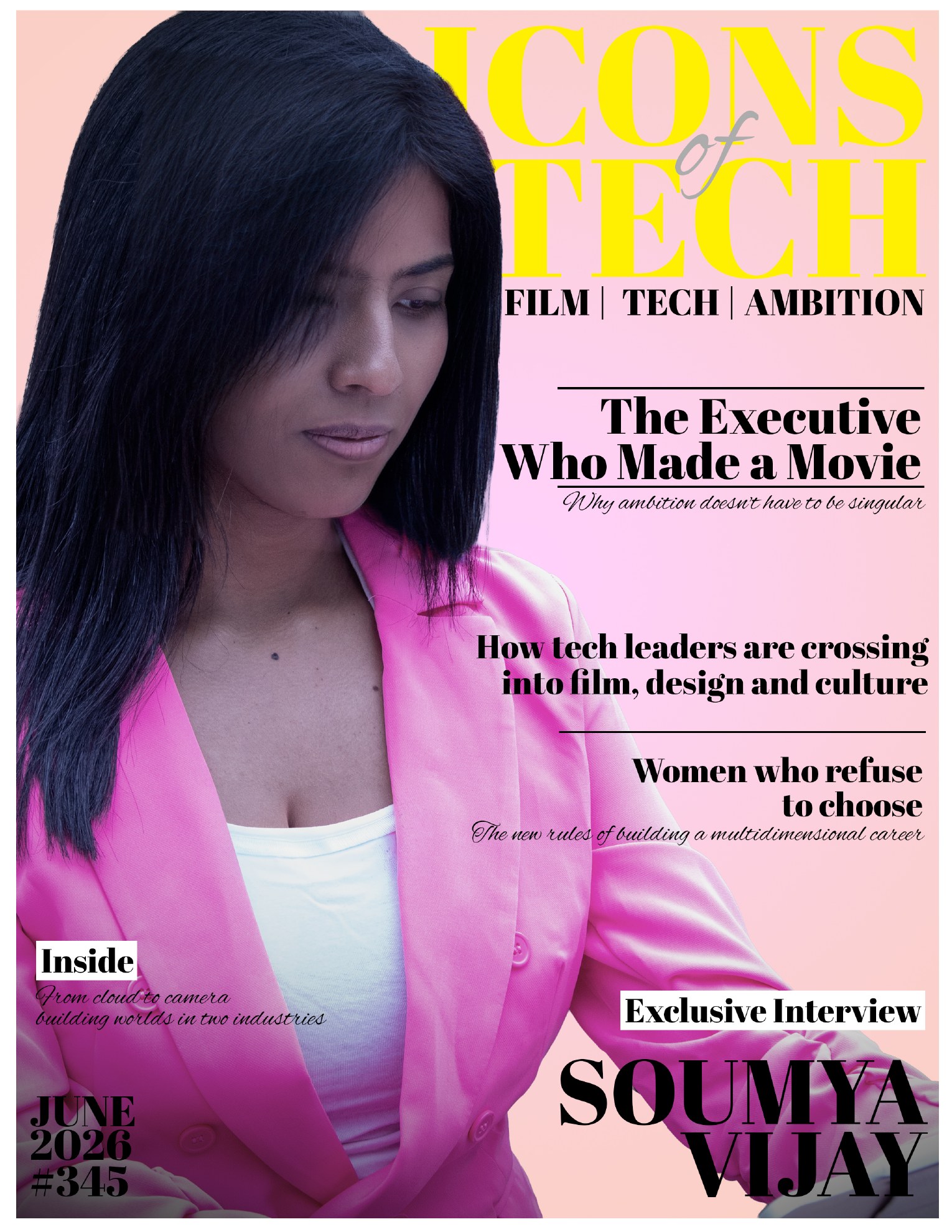
The Tech Executive Who Dared to Make a Movie
Why Soumya Vijay's journey matters far beyond Hollywood.
By Icons of Tech Editorial